Spider Solitaire
Master the Web: An Introduction to Spider Solitaire
Spider Solitaire is a timeless card puzzle where strategy and precision lead to victory as you clear the tableau. This version of Spider Solitaire provides a clean experience for enthusiasts.
Whether you are a casual player looking to unwind or a competitive strategist aiming for a high score, this version of the classic Spider Solitaire game offers a polished and immersive experience. By arranging cards in descending order from King to Ace, you engage in a rewarding mental exercise that tests your logic and foresight. Inspired by the traditional Windows era gameplay, this rendition of Spider Solitaire brings modern features like unlimited undos and smart hints to ensure that every session is both challenging and accessible.
A Versatile Challenge for All Skill Levels
What sets this Spider Solitaire experience apart is its adaptability. Players can choose from three distinct difficulty levels—1-Suit Spider Solitaire for a relaxing game, 2-Suit Spider Solitaire for a moderate challenge, or 4-Suit Spider Solitaire for those seeking a true test of skill. If you have enjoyed other staples like Klondike, Pyramid, or FreeCell, you will find the familiar mechanics and intuitive drag-and-drop controls of Spider Solitaire here to be a perfect addition to your daily gaming routine. With its clean design and responsive interface, it is the ultimate way to sharpen your brain on both desktop and mobile devices.
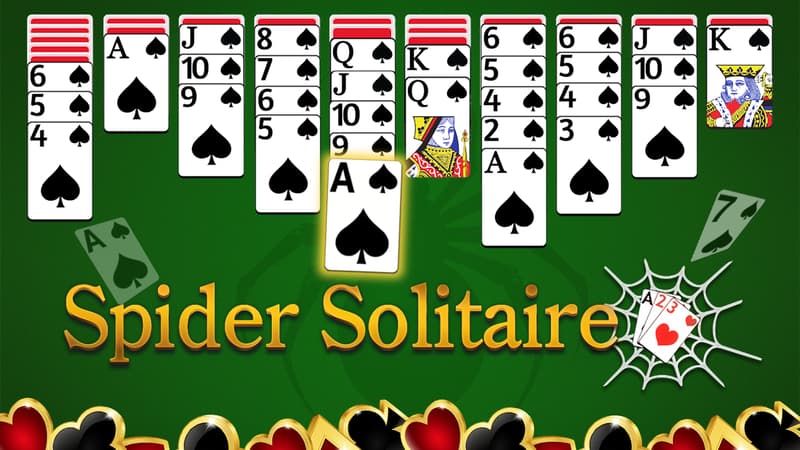
How to Play Spider Solitaire
Spider Solitaire is a sophisticated test of logic and foresight. While the premise is simple—clearing all cards from the board—the execution of Spider Solitaire requires a blend of tactical stacking and careful sequencing. Whether you are a beginner starting with one suit or a veteran tackling the four-suit challenge, understanding the core mechanics of Spider Solitaire is the first step toward mastery.
The Objective
The ultimate goal of Spider Solitaire is to organize all cards on the tableau into descending sequences of the same suit, running from King down to Ace. In Spider Solitaire, once a complete sequence (K, Q, J, 10, 9, 8, 7, 6, 5, 4, 3, 2, A) is formed, that set is automatically removed from the board. You win the Spider Solitaire game when the entire table is cleared and all suits are completed.
Game Mechanics and Rules
At the start of Spider Solitaire, cards are dealt into ten columns, with only the top card of each pile facing up. To reveal the hidden cards beneath, you must move the face-up cards to other columns as you play Spider Solitaire.
- Moving Cards: You can move a card or a group of cards onto another pile if the destination card is one rank higher. For example, in Spider Solitaire, a 7 can only be placed on an 8.
- Suit Constraints: While you can stack cards of different colors or suits to clear space (e.g., a Heart 6 on a Spade 7), you can only move a group of cards together as a unit in Spider Solitaire if they are all of the same suit.
- The Stock Pile: When you run out of moves in Spider Solitaire, click the stock pile to deal a new row of cards across all ten columns. Note that every column must contain at least one card before you can deal from the stock in Spider Solitaire.
- The Mixed Suit Option: In this version of Spider Solitaire, you can utilize the Mixed Suit feature to complete rows even if the cards aren't identical in suit, though following the classic Spider Solitaire rules remains the most rewarding challenge.
Controls and Interface
Navigating the Spider Solitaire game is seamless and intuitive. Using your mouse, you can interact with the Spider Solitaire UI, click the stock pile, or use the drag-and-drop functionality to shift cards between columns. If you find yourself in a difficult spot while playing Spider Solitaire, the interface provides Unlimited Undo to backtrack your steps and Smart Hints to highlight potential moves. Keep an eye on the Spider Solitaire statistics page to track your best scores and aim for a victory with the fewest moves possible!
Tips & Strategies for Spider Solitaire
Mastering Spider Solitaire requires more than just luck; it demands a keen eye for sequencing and a proactive approach to managing the tableau. Whether you are playing the beginner-friendly 1-suit Spider Solitaire mode or tackling the expert 4-suit challenge, use these strategies to improve your win rate and lower your move count.
-
Prioritize Emptying Columns Early One of the most powerful tools in Spider Solitaire is an empty column. An empty space allows you to temporarily move cards or entire sequences out of the way, giving you the freedom to reorganize the rest of the Spider Solitaire tableau. Try to clear out a column as quickly as possible to gain this tactical flexibility.
-
Build Sequences by Suit Whenever Possible While Spider Solitaire allows you to stack cards of different suits in descending order (e.g., a 7 of Hearts on an 8 of Spades), doing so "locks" the column. You cannot move a mixed-suit sequence as a group in Spider Solitaire. Always prioritize building within the same suit to keep your stacks mobile and ready to be transferred.
-
Expose Hidden Cards First Your primary goal in Spider Solitaire should be to reveal the face-down cards buried at the bottom of the stacks. Before dealing a new row from the stock, exhaust every possible move on the Spider Solitaire board that could result in flipping a hidden card. The more cards you have in play, the more options you have for building sequences.
-
Manage Your King Placements Wisely Kings are the highest-ranking cards and cannot be placed on top of any other card in Spider Solitaire. This means they can only be moved into an empty column. Do not vacate a column unless you have a King (or a sequence starting with a King) ready to occupy it, otherwise, you might waste a valuable Spider Solitaire movement slot.
-
Clean Up "Natural" Sequences Before Dealing Clicking the stock pile to deal a new row of cards often creates "blocks" by landing a random card on top of your carefully organized Spider Solitaire sequences. Before you deal, try to organize your columns into as many same-suit sequences as possible. This makes it easier to recover and reorganize once the new Spider Solitaire cards are dealt.
-
Use the Undo Feature to Scout If you are unsure which of two moves is better in Spider Solitaire, don't be afraid to use the unlimited undo feature. You can play out one path to see what hidden card lies beneath, and if it doesn't help your progress, undo your moves and try the alternative Spider Solitaire strategy. This is a great way to learn card patterns and improve your logic.
-
Think Several Moves Ahead Before moving a card just because it fits, look at what that move reveals or enables in Spider Solitaire. If moving a 5 onto a 6 doesn't uncover a hidden card or free up a column, it might be better to wait. Always ask yourself: "Does this Spider Solitaire move bring me closer to completing a full King-to-Ace set?"
FAQ about Spider Solitaire
How do I win a game of Spider Solitaire?
To win at Spider Solitaire, you must arrange all the cards on the tableau into descending sequences from King down to Ace within the same suit. Once a complete sequence (King through Ace) is formed, it is automatically removed from the Spider Solitaire board. The game is won when all cards have been cleared from the table.
What is the difference between 1-Suit, 2-Suit, and 4-Suit modes in Spider Solitaire?
These modes represent the difficulty levels of the Spider Solitaire game. 1-Suit (Easy) uses only Spades, making it simple to build sequences. 2-Suit (Medium) introduces Spades and Hearts, requiring more strategy to manage different colors. 4-Suit (Hard) uses all four suits (Spades, Hearts, Clubs, and Diamonds), providing the ultimate Spider Solitaire challenge for logic and planning.
Can I move a sequence of cards if they are not the same suit in Spider Solitaire?
While you can stack cards of different suits in descending order to clear space (e.g., placing a 6 of Hearts on a 7 of Spades), you can only move them as a group in Spider Solitaire if they belong to the same suit. Furthermore, only complete sequences of the same suit are removed from the Spider Solitaire tableau.
What should I do if I run out of moves in Spider Solitaire?
If you find yourself stuck, you can utilize the Unlimited Hint feature to suggest a move or use the Undo button to backtrack and try a different Spider Solitaire strategy. If no moves remain on the tableau, click the stock pile to deal a new row of cards to each column. Remember, all columns must have at least one card before you can deal from the stock in Spider Solitaire.
How is my final Spider Solitaire score calculated?
Your score is primarily determined by the number of moves you make and the number of suits you successfully clear in Spider Solitaire. To achieve a high score and a spot on the Statistics page, you should aim to complete the Spider Solitaire game in the fewest moves possible while minimizing your reliance on hints.
Next Adventures

Crossy Road
Crossy Road

Playground
Playground

Word Wipe
Word Wipe

Sprunki Clicker
Sprunki Clicker

Drift Hunters
Drift Hunters

Stickman Hook
Stickman Hook

Candy Clicker
Candy Clicker

Escape Road
Escape Road

Brainrot Clicker
Brainrot Clicker

Doodle Baseball
Doodle Baseball

Dinosaur Game
Dinosaur Game

Among Us
Among Us

Duck Duck Clicker
Duck Duck Clicker

Stimulation Clicker
Stimulation Clicker
Spider Solitaire
Spider Solitaire

Slope Unblocked
Slope Unblocked

Clicker Heroes
Clicker Heroes

Monkey Mart
Monkey Mart

Smash Karts
Smash Karts

Duck Clicker
Duck Clicker